About the Environmental Genome Initiative

The nonprofit Environmental Genome Initiative is collaborating with product manufacturers and industry associations, government agencies, foundations, and investors to map the content, design, manufacturing processes, and energy use for the 100,000 industrial chemicals-in-commerce used to make virtually all materials and products worldwide. These engineering-based datasets provide a new and far more accurate way to measure environmental impacts. EGI also advises organizations on sustainability and circularity planning.

Vision

The Environmental Genome database is a powerful collaboration resource to address some of the most pressing problems – and opportunities – of our day. Among them, a new way to measure environmental impacts throughout the supply chain and reduce global warming.

This transparent database maps the carbon and other environmental footprints of the industrial chemicals used in the trillions of materials and products used globally. It enables the detailed estimate of greenhouse gas emissions and provides the means for credible public disclosures of the direct and indirect emissions of manufactured products that regulators, investors, corporate procurement professionals, and customers are moving toward.

We are inspired by the successful completion of the Human Genome Project, which allowed researchers to map of the DNA code that makes up the human genome, and how that knowledge has been used to make significant impacts in the fields of oncology, pharmacology, rare and undiagnosed diseases, and infectious diseases.

We believe the Environmental Genome opens similar opportunities to research the relationship between pollutants and chronic disease, as well as for investment returns, knowledge sharing, analytics, and applications development. It embodies our deepest aspirations for making real progress.

Our History

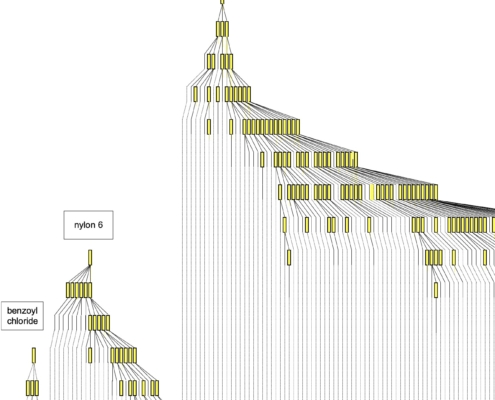
The nonprofit Environmental Genome Initiative was founded in 2017 after Dr. Michael Overcash, Ph.D., and a number of his scientific colleagues discovered a repeating pyramidal shape as they mapped detailed chemical manufacturing processes.

The group’s discovery piqued the interest of the scientific community when it was revealed in a paper published by Dr. Overcash in the Royal Society of Chemistry’s Green Chemistry Journal in March 2016.

The discovery was awarded the 2016 Innovation in Smart Chemistry Award, sponsored by Nike, NASA, the U.S. Department of State, the American Chemical Society Green Chemical Institute, and the U.S. Agency for International Development, attracting the interest of major corporations, public policymakers, and the philanthropic community.

Dr. Overcash, a chemical engineer and an environmental specialist who has developed industrial pollution prevention methods throughout his career, founded the organization with fellow scientists specializing in chemical engineering, industrial engineering, environmental health, and human health. Many in the group had focused their work on green energy, process and sustainable systems engineering, chemical circularity, as well as life cycle impact, and risk modeling.

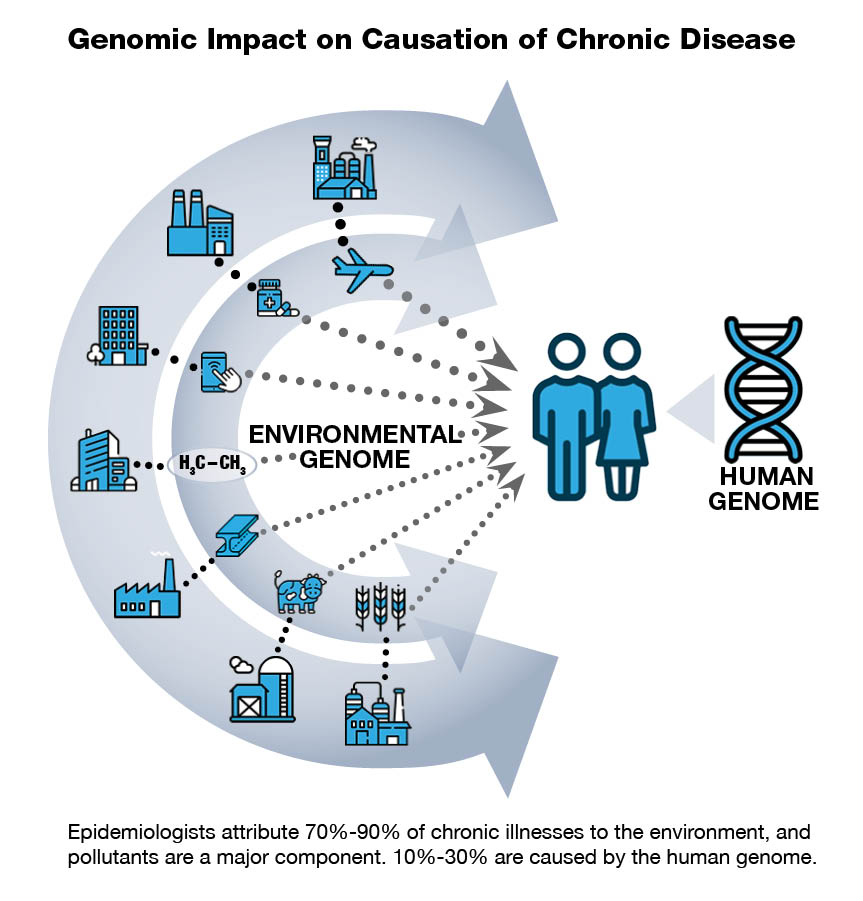
To date, more than 2,000 detailed chemical manufacturing processes with separate CAS numbers and representing a wide variety of molecular structures, elemental compositions, and commercial uses have been mapped to the database. The goal is to produce the map of the environmental footprints of all products by first establishing the carbon footprint of the industrial chemicals used, the critical base of any product. It will provide the primary data and the means for Scope 3 reporting of the indirect emissions of a company’s suppliers and its upstream and downstream supply chain activities.

Our Future

The nonprofit Environmental Genome Initiative promises to create a new ability to visualize and study the genomic structures of the chemicals we use to make all products — from their origins in the earth, through their manufacture and use, to how they enter our environment. This view the environmental footprints of our products will generate new insights into problems – and bring solutions – that will lead to safer, healthier lives for all.

Today the EG is the largest transparent chemicals/materials life cycle inventory database in the world – and growing. We aim to work together with people and organizations who share our goals and invite investors and foundations, product manufacturers and industry associations, and government agencies to work with us.

The repeating pyramidal pattern of molecular building blocks for three common chemicals, benzoyl chloride, nylon 6 and paroxetine. Each of the pyramidal shapes shows the aggregation of processes that make up the supply chain – from the sourcing of raw materials from the ground at the base of these structures, through the progression of intermediates in the supply chains, to the chemical product at the top.

Our Goals

  1. Build on a well-developed system, tested already on 2,000 chemicals, to map the 100,000 chemicals-in-commerce used in all materials and products we utilize or consume globally.
  2. Drive down the time and cost to map each segment of the genome through better data mining, physical properties techniques, and genome structure mapping.
  3. Move through four funding stages while using the database to support analytics and applications that further sustainability efforts.
  4. Expand and initiate teams (of approximately 25 genome developers and two manager/review specialists) in multiple U.S. and international locations to continue the mapping process.
  5. Develop flexible specialist teams to guide the mapping process for greater efficiency, to verify waste management effects, to increase the capacity of the mapping tools and database, and to identify funding for research and development projects that utilize genome information with outside groups.
  6. Encourage broad support and collaboration from the chemical/materials manufacturing and public health sectors.

Applications for the Environmental Genome Database

National Competitiveness and Security

  • Reduce dependence on foreign supply chains
  • Identify undisclosed production of chemical weapons
  • Unauthorized production of cyber technology such as stealth coatings
  • Measure chemical discharges after natural or manmade accidents and events
  • Corporate patent violations

Public Health Information Related to all the Products we Consume

  • Estimate the health impacts of exposures to emissions to air, water, and land
  • Develop new life science applications
  • Research and improvements in the social determinants of health (SDOH) with manufacturing plant data on emissions and disability-adjusted life years (DALY)
  • Quantify the environmental pollutant origins affecting nearly one billion people globally with chronic diseases
  • Research on ways in which maternal fetal health is impacted by exposure to environmental pollutants
  • Quantify environmental disparity
  • Estimate fugitive emissions

Compliance, Communications and Competitiveness

  • Compliance with local, national, and international environmental regulations
  • Carbon footprint
  • Environmental Product Declarations
  • Building certification
  • Health, safety, and sustainability claims
  • Product comparisons
  • Product cost reductions
  • Product labeling
  • Increase competitiveness through chemical improvements and innovation 
  • Safety and risk assessments
  • Sustainable procurement
  • Water footprint

Manufacturing and Product Design Improvement

  • Energy and mass efficiency
  • Analysis to facilitate technological innovations for energy and material conservation, improved processes, and sustainable product designs
  • Better manufacturing supply chains
  • Lower costs due to pollution prevention, reduced water and carbon impacts, and greater efficiencies
  • Quantify the environmental impacts of new chemicals, materials, colors, coatings, etc. in product designs
  • Tools that meet the fast-paced demands of the product design process
  • Capture customer benefits in environmental improvements

More Information

  • Green Chemistry EGIP article

    The discovery of the environmental genome for industrial products was published by the Royal Society of Chemistry in the Journal of Green Chemistry. The full paper includes the origin of the repeatable structure of the environmental genomic segments and the implications for mapping the full genome.

For more information, contact:
Dr. Michael Overcash
Email mrovercash@environmentalgenome.org or mrovercash@earthlink.net
Call 919-571-8989 or 919-801-6064
We work directly with Environmental Clarity environmental clarity.com
© Copyright - Environmental Genome